Free Cover Letter Generator for No Experience, Students and Career Changers
Whilst AI can create a cover letter, it does so based on input. Where someone’s experience is limited, it is essential to input the correct information so that the output is not also limited.
Many sources of cover letter information assume that you know what job title to include. However, students, new graduates and those switching sector often don’t. The standard format (“In my five years as...”) is therefore unhelpful and a blank document is also unattractive.
Although a free AI generator could be of assistance, it is crucial that you understand how ethical generators function. They do not ‘create’ experience, skills and outcomes; rather, they base their output on your resume. Therefore, the quality of your generated letter will largely depend on the data you input. Here is how to do this.
Can I generate a cover letter if I have no experience?
Whilst ‘no experience’ usually means you have had no full time experience in the area, you will almost certainly have undertaken some learning, part-time, voluntary and/or self-initiated work. A generator can convert this into a letter, but cannot find it for you. Unless you include it in your resume or in your input, it will not be included in the generated letter.
Creating made-up experience is not helpful. In interviews, you will be questioned about it.
What to input for generation
Prior to uploading your resume (or indeed a separate version of it, which you use solely for generation), take 10 minutes to include the following information:
- Projects – for instance, a course project, a final year project, a self-designed app or a spreadsheet for a club. Include a brief statement of what it involved and its outcome.
- Courses – only those relevant to the job. For example, “data structures” for a developer and “financial accounting” for an analyst.
- Part-time and casual work – in sectors such as retail, hospitality, tuition and call centres, you can highlight skills including dependability, customer service and managing pressure. State which jobs you have undertaken.
- Voluntary and club work – particularly if this involved leadership, tuition, financial management or organisation.
- Software/other tools – for example, Excel, Figma, Python, Canva and point of sale (POS). Again, be precise.
Input the complete job description. Only then can the generator analyse this and relate it to your experience.
Student and new graduate cover letter guidance
Do not begin with “I am a recent graduate of”. This is identified from your resume. Rather, start with the single piece of experience most relevant to the job.
Weak opening:
“I am a final-year business student and I am writing to apply for the Marketing Assistant role.”
Better opening:
“For my final-year project I ran the Instagram account for our campus food bank and grew it from 300 to 1,100 followers in one semester, which is why your Marketing Assistant role caught my eye.”
Please enter your own figures. If you don’t have these, clearly and honestly state what you did. Never falsify information.
Generally, a cover letter should be no more than three paragraphs. The first should act as an attention-grabber. Next, provide one or two further pieces of experience relevant to the job. Finally, state why you are keen on the company. If the job advert specifies an internship or graduate scheme, include the exact name of this.
Career changer cover letter guidance
Whereas students struggle to convey experience, career changers often have large amounts of it – but not necessarily of the type required. Unfortunately, it is common to try to conceal a career shift and hope that the recruiter does not detect it. They will though.
State in the initial two lines that you are making a career move and then demonstrate transferable skills:
“After six years as a high school teacher, I’m moving into instructional design. I’ve spent those years planning lessons for 150 students a term, building online course material during remote teaching, and turning feedback into better units, which is most of what your Learning Designer role describes.”
Then identify two or three skills from the job description that you have genuinely applied. Provide a brief example for each. If you have undertaken any training, a course or self-initiated project in the new sector, refer to these. However, do not make these the main focus of your letter. Authentic experience is generally more persuasive.
It is also beneficial to include, above the pasted job description, a statement such as “I’m moving from teaching into instructional design.” This enables the generator to recognise the nature of your career move and so avoid producing a generic teacher letter.
Amending a generated letter
All AI-generated letters require amending. For a no-experience letter, specifically check:
- That claims are justifiable. For example, if the letter states that you “led a team”, but you were in fact one of four in a group, amend this.
- Statements about enthusiasm and team-working. These are uninformative. Replace them with concrete examples or remove them.
- Excessive self-deprecation. Avoid beginning with “Although I lack experience...” Allow your experience to ‘speak for itself’.
- That the company and job titles are correct. Ensure that you have not erroneously included the name of the last company you applied to.
- That the letter is less than one side of paper. Usually, for entry-level positions, brevity is preferable.
Finally, read it aloud. If any section seems unlike something you would actually say, rephrase it in your own words.
Is a cover letter suitable for entry-level roles?
Often, yes. And arguably it is even more important for these roles than for those for more experienced candidates. With a limited resume, a cover letter is often the only place where you can emphasise why you – despite your background – are appropriate for a given role. Even if a letter is not compulsory for an application, a concise and targeted one is still more useful than a non-existent one. For further information, please see do you need a cover letter.
SealApply’s free generator
SealApply’s cover letter generator is free and requires no registration. Upload your resume as a text-based PDF, DOCX or TXT file. Paste in the job description and within 15–30 seconds a letter will be generated. As previously explained, the generator relies on your resume and so will not ‘fabricate’ extra experience, skills and outcomes. Hence it is extremely important that you include additional information such as projects. None of your uploaded information is stored.
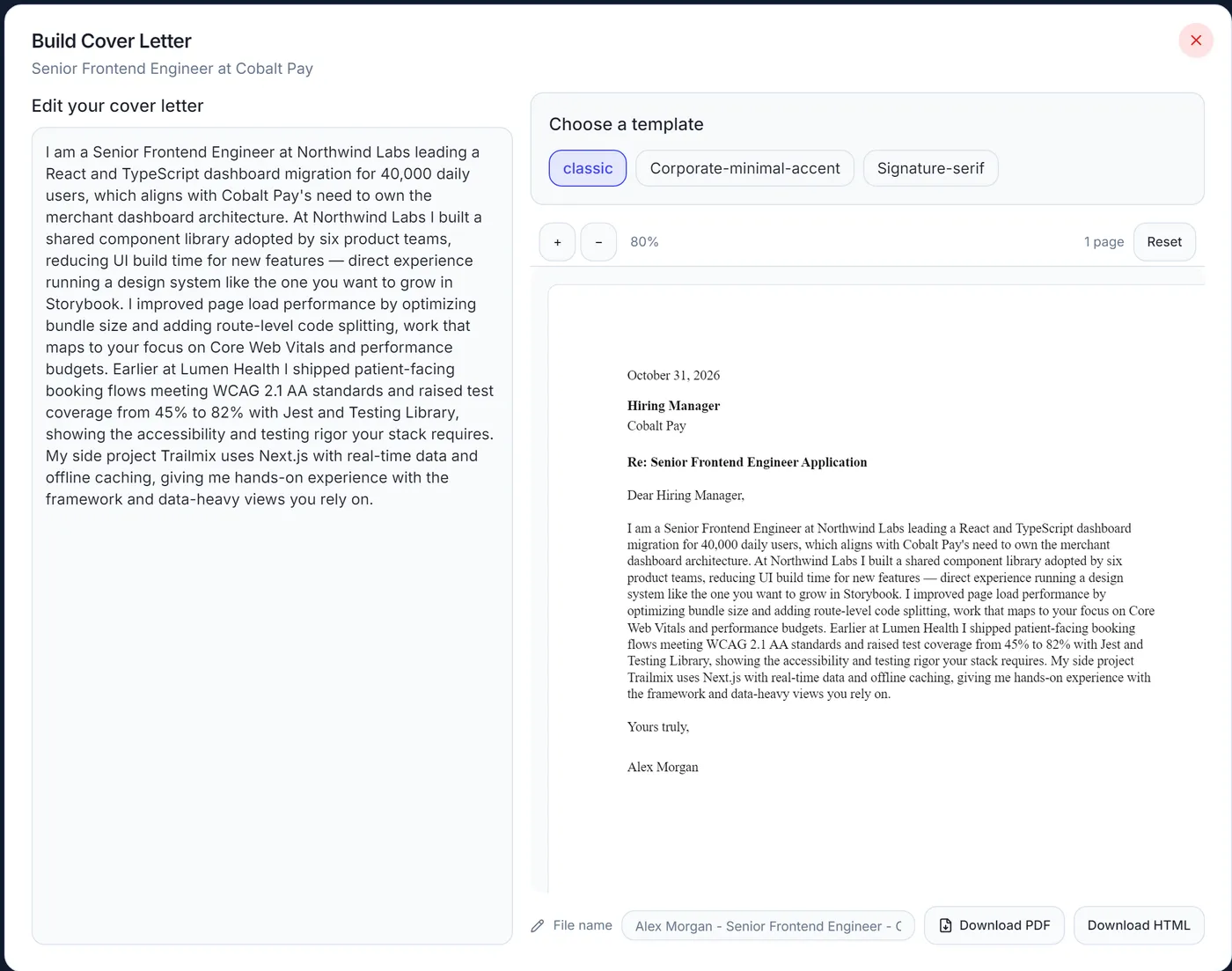
Once generated, you may copy the letter or download it as a text file. If you wish to amend it, continue in SealApply with the same resume and job details already entered. There you can edit the letter, choose between three templates and download it as a PDF.
Free tools: try this on your own job
Score jobs against your resume
Tailor your resume to a job
Build a new resume with AI
Write a cover letter in the app
Want a letter right here, with no sign-in? Use the free cover letter generator. All generators
Frequently asked questions
Can I use a free cover letter generator if I have no work experience?
Yes. Input your projects, relevant courses, part-time and voluntary experience. As a generator can only base a letter on your resume, if this is blank then it will not be able to generate a high-quality letter. Therefore, correct input is key.
What should students include in a no-experience cover letter?
Start with the single area of experience (project, course or part-time work) most relevant to the job. Then, add one or two further, succinctly-worded pieces of experience which are relevant to the job description. Do not include a line identifying yourself as a student or graduate as this is already shown on your resume.
How do I write a cover letter for a career change?
Explicitly state in the first two lines that you are changing sector. Then, identify two or three transferable skills from your existing career and provide a succinct example of how you have applied each. If you have completed a course or gained a certificate in your new area of interest, refer to this. However, your actual experience should remain the primary focus.
Should I mention that I have no experience in my cover letter?
No. You should not apologise for lacking experience. Instead, focus on detailing the experience you do have which is relevant to the job in question. It is then up to the recruiter to draw their own conclusions.
Do recruiters recognise that a cover letter has been generated by AI?
Frequently, yes. Often it is the use of generic statements regarding enthusiasm and team-working, without accompanying examples, which exposes a letter as having been AI-generated. A letter based on your own projects and then amended in your style will appear authentically yours, as it contains your own factual information.
How long should an entry-level cover letter be?
Typically less than one side of paper. Generally, a cover letter should comprise three concise paragraphs. Brevity is usually preferable for entry-level applicants, even if this means that the letter is shorter than the space available.
See how SealApply works
More from the blog
Best Free AI Cover Letter Generators 2026–2027 (Free Forever, No Trial)
AI cover-letter tools compared on what their free tiers give you: where the input comes from, how many prompts you get, whether you need an account, and whether the download is usable.
Best Free Cover Letter Makers 2026–2027 (Free PDF, No Watermark)
A free editor is only half of it. These cover-letter makers are compared on the file you end up with: PDF access, download caps, watermark rules and how trials are worded.
Free Application Letter Builder and Maker: Format, Example and Template
The application letter is the formal one-page letter that goes with your CV. The format employers expect, a complete example, and a free way to build one from your resume and the job post.
How to answer “Why do you want to work here?” (with examples)
A formula in three parts, sample answers for new grads, career changers, big companies and startups, and the mistakes that make an answer sound generic.
Try it on your next application
SealApply tailors your resume to the job, checks it against the ATS and fills in the form for you to review. Free, and your resume stays in your browser.
See what SealApply does